TTArtisan’s new AF 50mm f/1.8 Neo is a lens built on a simple and somewhat controversial premise: modern mirrorless shooters do not need physical controls on their glass. No aperture ring. No manual focus ring. Just a barrel, a mount, and an STM motor. At $89, the question is whether that trade-off makes the Neo a smart buy or a compromised one.
I tested the Sony E-mount version across three cameras — the Sony A7V and Nikon ZR (both with K24Tech) and the Sony FX3 (with Femi) — to give you a real-world answer rather than a spec-sheet one.
Build and In-Hand Feel
At 157 grams, the Neo is lighter than it looks. The metal mount is reassuring at this price point, and the housing feels solid rather than plasticky. The 52mm filter thread is standard and easy to work with. What you notice immediately, and cannot stop noticing, is the smooth barrel. There is simply nothing to grab. That is the Neo.

Autofocus on the Sony A7V
This is where the Neo earns its price. On the A7V, autofocus acquisition is fast and confident. Eye and face tracking engages quickly and stays locked during movement. For a third-party lens at $89, this performance is above what you would reasonably expect. The STM motor is quiet and smooth in operation.
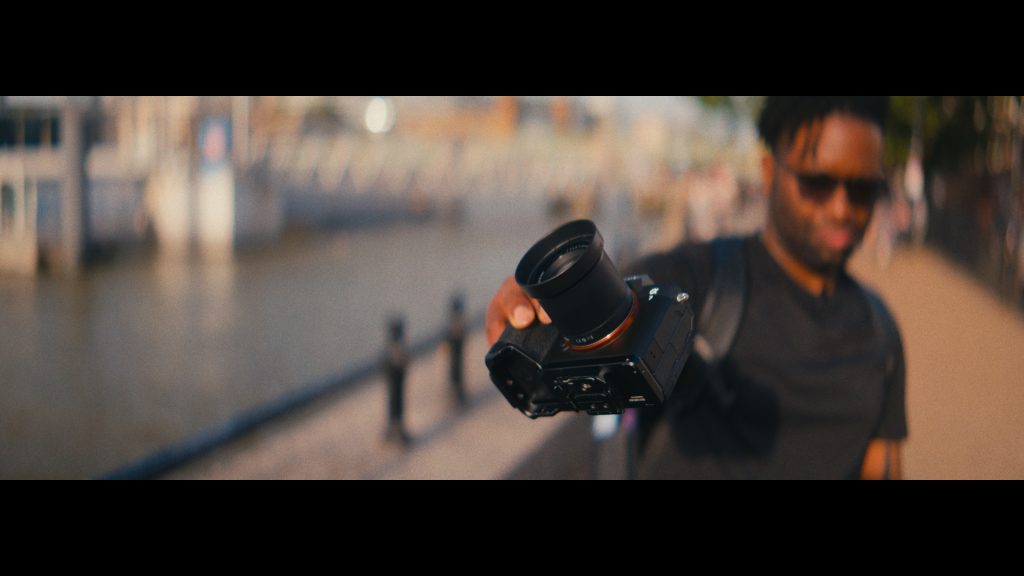
Nikon ZR + MegaDap Adapter — The Honest Finding
Tested on Femi’s Sony FX3, the flare handling at f/1.8 is not the Neo’s strongest suit. Scatter and wash around point light sources is noticeable wide open. Stopping down to f/2.8 improves things, and by f/4, the flare is controlled and clean. For night shoots with point sources in frame, f/4 is your friend with this lens.
Lens Flare and Starburst
Tested on Femi’s Sony FX3, the flare handling at f/1.8 is not the Neo’s strongest suit. Scatter and wash around point light sources is noticeable wide open. Stopping down to f/2.8 improves things, and by f/4, the flare is controlled and clean. For night shoots with point sources in frame, f/4 is your friend with this lens.
Bokeh Rendering
At f/1.8, the bokeh is decent for the price. The onion ring structure is minimal, but there is a faint secondary dark element visible inside each circle at wide apertures. As you stop down, the out-of-focus circles tighten and close up rather than staying open. It is not the most cinematic rendering available, but it is honest for an $89 optic and more than serviceable for most professional applications.
Focus Breathing
Focus breathing is present on the Neo, particularly noticeable on a slow rack from close to infinity. For cut-driven editing, it is largely irrelevant. For narrative work where rack focus is used as a creative device within a single take, it is worth being aware of.
Sharpness
No lab tests were conducted for this review. Real-world shooting on the A7V and FX3 returned results that look sharp to a working filmmaker’s eye. Centre sharpness at f/1.8 is solid. Edges improve noticeably at f/2.8. I would not hesitate to use this lens on paid work as a supporting optic.
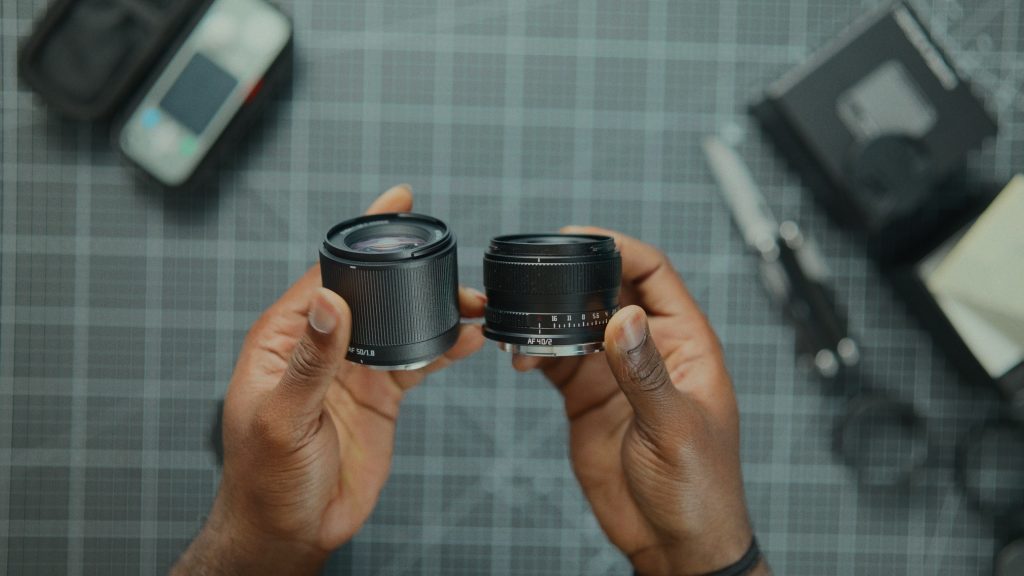
TTArtisan 50mm NEO f/1.2 vs TTArtisan 40mm f/2
The No-Controls Conversation
TTArtisan’s decision to remove the aperture ring and manual focus ring is a genuine point of discussion, not just a footnote.
Their logic is sound for a specific user: if you shoot Sony mirrorless, use the body’s AF system, and control aperture through the rear dial, the rings are redundant hardware. You are not using them. So the Neo removes them and passes the savings to you.
The problem is that this assumption does not hold for every shooter. If you need tactile lens control, work with a focus puller, or shoot on systems where the lens is expected to carry its own controls, the Neo design will frustrate you. There is no workaround.
I hope to own the L-mount version of this same lens. On a Lumix body, where aperture is controlled through the rear dial anyway, the absence of a ring would feel normal in practice. But the Neo is not for everyone.
Verdict
Buy — if you are a Lumix, Sony, or Nikon shooter working within a budget, rely on autofocus, and do not need manual lens controls. The AF performance alone justifies the $89 asking price.
Skip — if you are a filmmaker who needs physical focus or aperture control on the glass, or who regularly adapts lenses across different systems.
Consider — if you are curious but unsure. At $89, the cost of finding out is low.
Where to Find It – L-Mount, Sony E, Z-Mount for $89
🛒 Official TTArtisan website http://bit.ly/4gk4AqS
🛒 Amazon: http://geni.us/O430X
🛒 AliExpress: http://s.click.aliexpress.com/e/_c4NIkffX